
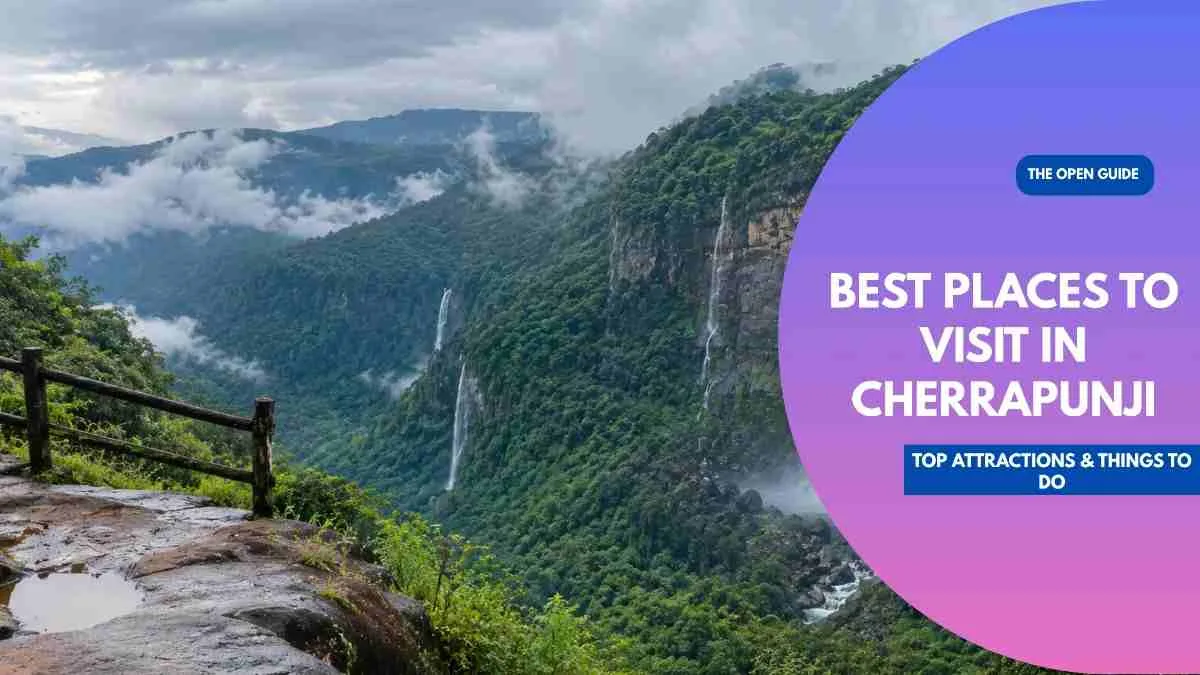
For a single day trip from Shillong, prioritize Mawkdok Dympep Valley viewpoint, Nohkalikai Falls, and Mawsmai Cave — all close together and manageable in a few hours. Give the Double Decker Living Root Bridge trek at Nongriat its own full day; it’s the highlight of the region but it’s a physical undertaking, not a quick stop.
Decide your season before anything else. That single choice reshapes the entire trip.
Best Time to Visit Cherrapunji: Winter or Monsoon?
Most guides tell you November to February is the best time to visit Cherrapunji, and they’re not wrong — the roads are dry, the sky is clear, and you can actually see the valleys instead of a wall of mist. What they don’t say clearly enough: several of the signature waterfalls, including Seven Sisters Falls, are seasonal. They run heavy during the monsoon and shrink to a trickle — sometimes close to nothing — once the rain stops.
So if you came for the postcard shot of seven simultaneous cascades, you want June through September, rain gear and all. If you came for comfortable sightseeing, clear photography, and a trek you won’t be doing on slick stone steps, you want the winter window. Nohkalikai Falls holds water year-round and looks good in both seasons, which makes it the safer bet regardless of when you’re going. Everything else, check the season against what you actually want to see before you build the itinerary around it.
Nohkalikai Falls
At roughly 1,115 feet, this is the tallest waterfall in India, and it earns the reputation. There’s a viewing gallery at the top with a genuinely wide panorama, and the pool at the base turns a deep turquoise that photographs well from any distance. The name comes from a local legend — “Likai’s leap” — about a woman who jumped from the cliff above, and it’s worth asking a local guide for the full story rather than reading the two-line version online. This one works in most seasons and is an easy stop, no trekking required.
Seven Sisters Falls (Nohsngithiang Falls)
Seven separate streams dropping down the same limestone cliff face, visible from a roadside viewpoint without any real walking. Beautiful when it’s running. The problem is that “when it’s running” means monsoon season specifically — outside of heavy rain, the falls thin out dramatically, and you may arrive to find one or two threads of water where the photos showed seven. If seeing this at full flow matters to your trip, plan around the rains, not around your own comfort.
The Double Decker Living Root Bridge (Nongriat trek)
This is the one attraction on this list that deserves its own paragraph of warnings before the praise.
The bridge itself is remarkable — a functional structure grown from the aerial roots of rubber fig trees, built and maintained by Khasi communities over generations, strong enough to hold real foot traffic. Getting to it means descending a long stone staircase from Tyrna village down to Nongriat, somewhere in the range of 2,500 to 3,500 steep steps depending on which stretch you count, and then climbing every one of them back up. Figures vary by source; what doesn’t vary is that this takes real stamina, not casual sightseeing energy. Budget half a day at minimum, more if you also want to see Rainbow Falls further down the trail, and know that the climb back up is the part that actually tests you.
Some travelers break the trek into two days and stay overnight in a Nongriat homestay rather than doing the round trip in a single push. If your schedule allows it, that’s the more comfortable version of this trip, not a compromise.
Do not treat this as one stop among five on a single day’s itinerary. It is the day’s itinerary.
Mawsmai Cave
A limestone cave a few kilometers from central Cherrapunji, and — unlike some of the region’s other caves — lit well enough that you can actually see the formations rather than fumbling with a torch. Only a portion of the cave, around 150 meters, is open to visitors, which keeps the visit short: twenty to thirty minutes, no special fitness required, and a reasonable option if the weather has ruled out anything outdoors.
Mawkdok Dympep Valley viewpoint
A roadside stop on the way into Cherrapunji from Shillong, sitting around 1,400 meters up, looking out over a valley that’s usually softened by mist. It’s not a destination you build a day around, but it’s on the route anyway, so there’s no real reason to skip it. Ten minutes, maybe fifteen if you’re taking photos.
Dainthlen Falls and Wakaba Falls
Two smaller, less crowded falls, both worth a stop if you have time left over rather than being the reason you came. Dainthlen has carved rock faces at the top depicting a local legend about a python; Wakaba sits further from the main road and gets fewer visitors, which makes it a decent picnic spot if you want somewhere quieter than the headline attractions. Neither needs more than half an hour.
Beyond Cherrapunji: Mawlynnong & Mawsynram
If you have an extra day, Mawlynnong known for community-led cleanliness and a living root bridge of its own and Mawsynram, often cited as the wettest place on Earth, both sit within day-trip range. Neither replaces a Cherrapunji visit; they extend it.
Getting to Cherrapunji: Distance and Transport
- From Shillong: around 54 km, roughly a two-hour drive – fog and rain slow this road down more than the distance suggests, so build in extra time outside the dry winter months.
- Shared taxis: run from Shillong’s Anjali Cinema taxi stand and are the budget option.
- Private cab for the day: costs more but gives you control over timing, which matters if you’re trying to catch a viewpoint before the afternoon mist rolls in.
- If Nongriat is on your itinerary: Tyrna village, the trailhead, is a further 15 to 20 km from central Cherrapunji — factor that leg in separately rather than assuming you’ll walk straight off the main road and onto the steps.
Cherrapunji Itinerary: How to structure 1, 2 or 3 days
- One day, coming from Shillong: Mawkdok Dympep Valley on the way in, then Nohkalikai Falls, then Mawsmai Cave, then back. A full but comfortable day without a trek in it.
- Two days: keep day one as above, and dedicate day two entirely to Nongriat and the root bridge, starting early enough to be back at the top before dark.
- Three days or more: fold in Mawlynnong, Mawsynram, or an overnight in Nongriat itself instead of the round trip in one day.
Mistakes Worth Avoiding
- Scheduling the root bridge trek as a “quick stop” between two other attractions. It isn’t quick, and treating it as an afterthought is how people end up rushing the descent, the part where a slower pace actually matters more.
- Visiting in December expecting Seven Sisters Falls to look like the photos. Check what’s actually running before you build a whole day around one waterfall.
- Skipping food and water for the trek because Cherrapunji town has plenty of both. Once you’re past Tyrna and heading down, options thin out to a handful of small stalls selling water, chips, and instant noodles roughly midway — enough to get by, but not something to rely on for a proper meal before the climb back up.
Where to Start
If you’re deciding right now, start by choosing your season based on whether you want the waterfalls at full flow or sightseeing at its easiest. Then decide whether Nongriat deserves its own day or an overnight stay. From there, you can plan the best places to visit in Meghalaya around these two decisions.
